A lot of people will tell you a car doesn't belong in your net worth, because it only loses value. It does belong there. Count it at what it would sell for today, and count its loan right beside it.
Get it wrong and your total can be off by a lot. The usual reasons for leaving it out don't hold up.
A car that loses value still counts
Losing value doesn't make something stop being yours. The OECD's measure of household wealth, used to compare countries, takes net wealth as what a household owns minus what it owes, and it lists "cars, motorcycles, boats, other vehicles owned by household and used for private purposes" among the things it owns. (OECD Wealth Distribution Database, "Main concepts")
The test behind it is simple, wherever you live. If you could sell the car tomorrow and keep the money, it's something you own. A falling value just means the number you type gets smaller over time.
Leave out the car and keep the loan, and you look poorer than you are
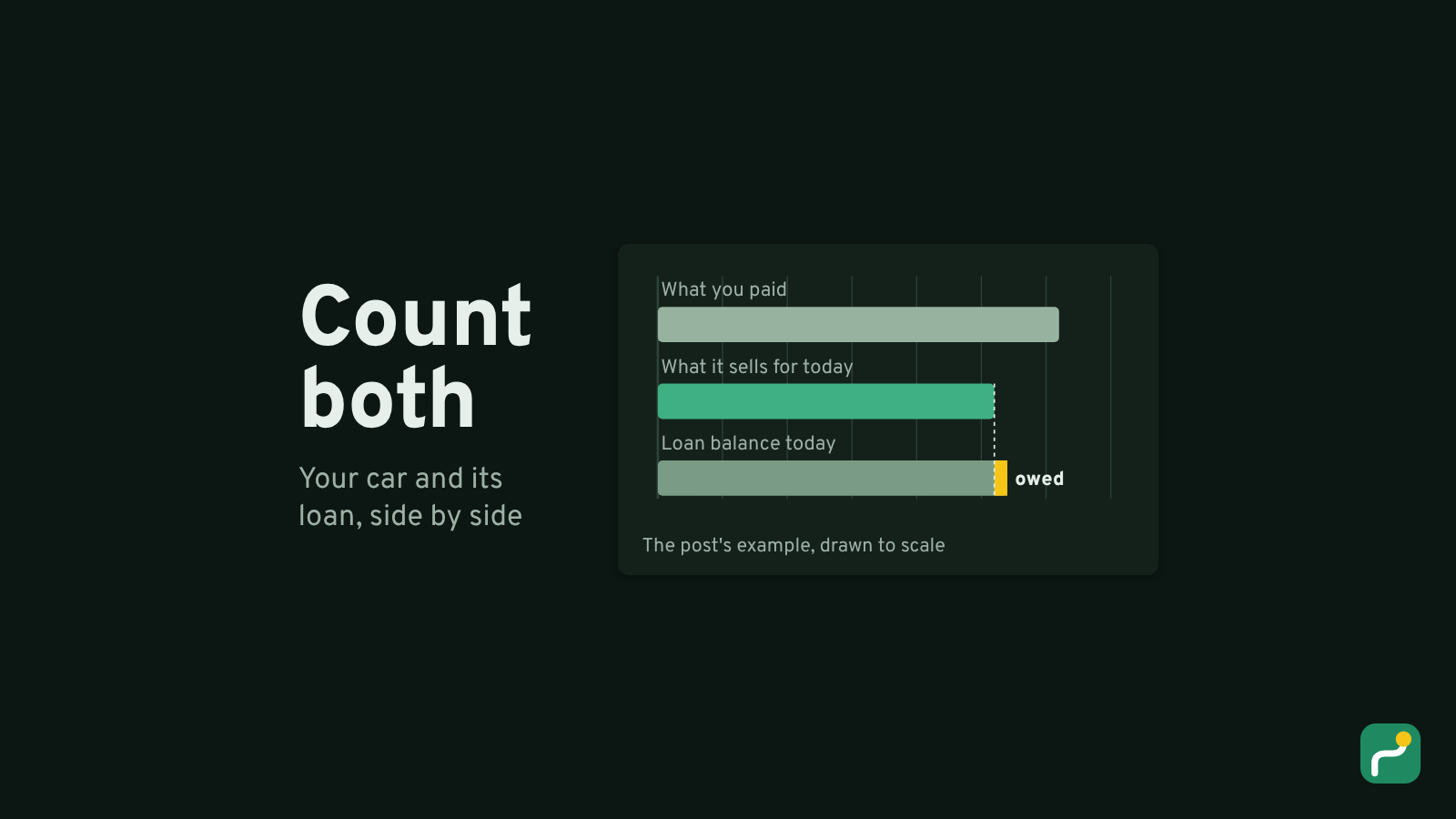
Say you bought a car six months ago for $31,000, mostly on a car loan. Today it would sell for about $26,000, and the balance your lender shows on the loan is $27,000. This is an example.
Now you sit down to add it all up. The loan has to go in: it's money you owe, and it stays owed whether you count the car or not. If the car stays out, the total carries the whole $27,000 owed. Put the car in, and the two together come to $1,000 owed. Leaving the car out makes the total wrong, on the low side, by the car's whole value.
The loan can't come out, so the car goes in too.
What you paid isn't the number
The price on your paperwork was true for one afternoon. As the car gets older, it's usually worth less.
Type the price you paid, and the example car turns your total around: you'd see $4,000 on the plus side, when the truth is $1,000 owed. Type what the same model, year and mileage is selling for near you today. A dealer's trade-in offer and a private buyer's price can be quite different. Either works, as long as you pick one kind and look it up the same way every time. Then the number moves because the car changed, not because you switched where you checked.
For the loan, type the balance your lender shows, not all your remaining payments added up: those include interest you don't owe yet. Here's why the lender's balance is close enough.
The car and its loan don't cancel out
It's easy to think of the car and the loan as one thing that comes to zero. They're two numbers that move on their own. The loan shrinks with each payment. The car keeps slipping, whatever you pay.
If you borrowed to buy a car, you can owe more on the loan than the car is worth. That's called negative equity, and it's where the example car sits today, at $1,000 owed. It can happen early in a loan, when the car has lost value faster than the balance has come down, and it changes as the loan gets paid down and the car gets older.
Trading the car in doesn't make the gap disappear, either. If the difference gets added to the loan on your next car, you still pay it, and in your net worth it turns up again inside the new loan.
Your car will drop a little almost every month
On paper or in an app, keep the car and the loan as two lines, one on each side. In Renav, the car is its own account with the type Vehicle, under What you own, and the loan is a separate account under What you owe. When your monthly check-in reaches the car's Update balance step, type what it would sell for today and tap Save. The car's row in your accounts then shows something like "Down $800 since your Oct 1 balance".
Saving and paying down the loan move your total up. The car pulls it down a little almost every month, however careful you are. That drop is what a car does, and a total that shows it is more honest than one that leaves the car out.