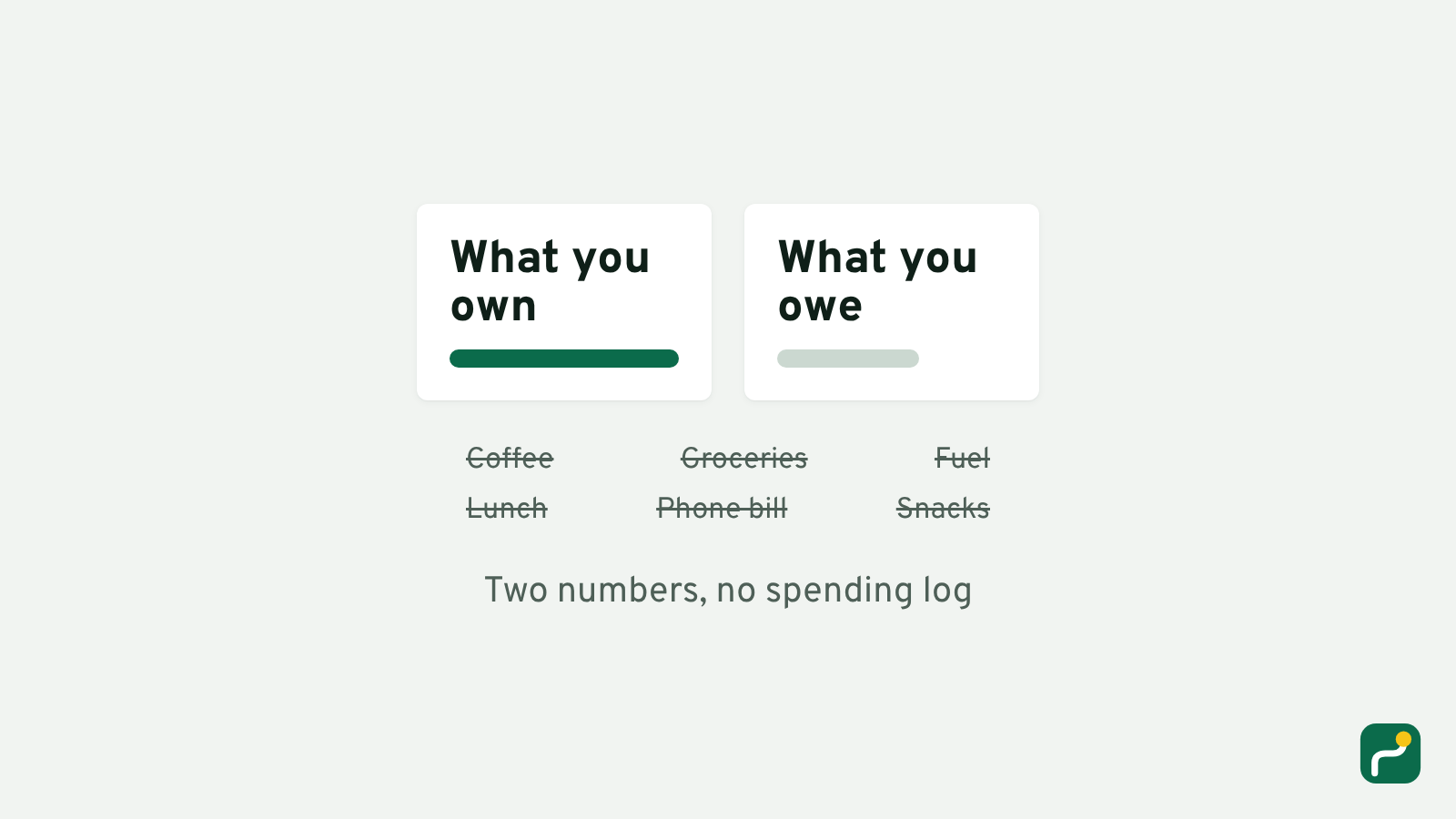
Most money apps open by asking what you spent. Renav doesn't. There's no budget to set, no spending categories and no list of every purchase. You tell it what each account holds today and what you still owe, and it shows you those two totals side by side.
People sometimes read that as a missing feature. We left it out on purpose, and here's the reasoning.
Two numbers tell you where you stand
What you own and what you owe. Money in an account is yours, even if it earns very little, so Renav counts it. A debt stays until it's paid, whether you look at it or not, and its interest keeps adding up in the meantime. Paying it down is what moves it.
Writing down last Tuesday's groceries moves neither number. That purchase is already in your bank balance. Logging it a second time tells you where the money went, not where you stand.
A budget didn't change what people spent
The clearest test we've found ran in 2019. Irrational Labs and Duke's Common Cents Lab split 9,035 users of a money app into three groups for 13 weeks: one set a single monthly spending number, one set a budget for each category, and one set nothing. The three groups' spending came out within about $8 of each other, and the people with a budget overspent it by 1.3 to 1.4 times. (Irrational Labs, "Does Budgeting Help You Save Money?", 2019)
It's one study, written up on the company's own blog rather than in a journal, and nobody has repeated it yet. We still take it seriously, because it lines up with what most people who've kept a budget already suspect.
Keeping a diary teaches prices, not saving
A second study gave a money-diary app to 390 students finishing school in Piura, Peru, for six months. They came out knowing prices noticeably better. Whether they budgeted or saved didn't change in any significant way. (Frisancho, Herrera and Prina, Journal of Economic Behavior & Organization, 2023)
That study paired the app with regular visits from the researchers' staff and text messages, so it can't say what the diary alone did. But neither study found that writing spending down made people save more.
"But I need to know where my money goes"
Sometimes you do. If a month went sideways and you can't tell why, scrolling through your bank's own history for an evening is worth it, and your bank already keeps that list for you.
What your bank app doesn't show is the other half: the card at one bank, the loan at another, the savings somewhere else, with the date you last recorded each. Renav puts them on one screen.
There's also a limit we'd rather be honest about. Renav can't tell a deposit from a market gain, so it never claims to know how much you put in this month or what you spent. It knows the balances you recorded, and when you recorded them.
What the figures on screen mean
A balance is a snapshot, not a transaction history. Renav doesn't see deposits, purchases or anything you didn't enter. Schedules and goals are records you keep up yourself. Every total is arithmetic on your own figures, with its assumptions shown beside it, and it can't account for details you left out.
What Renav asks of you instead
About once a month, tap Update balance on each account and type in what your bank shows. That's the whole habit.
If you'd like to see your two totals first, add up what you own and what you owe. When you want to keep them, you can start free.